
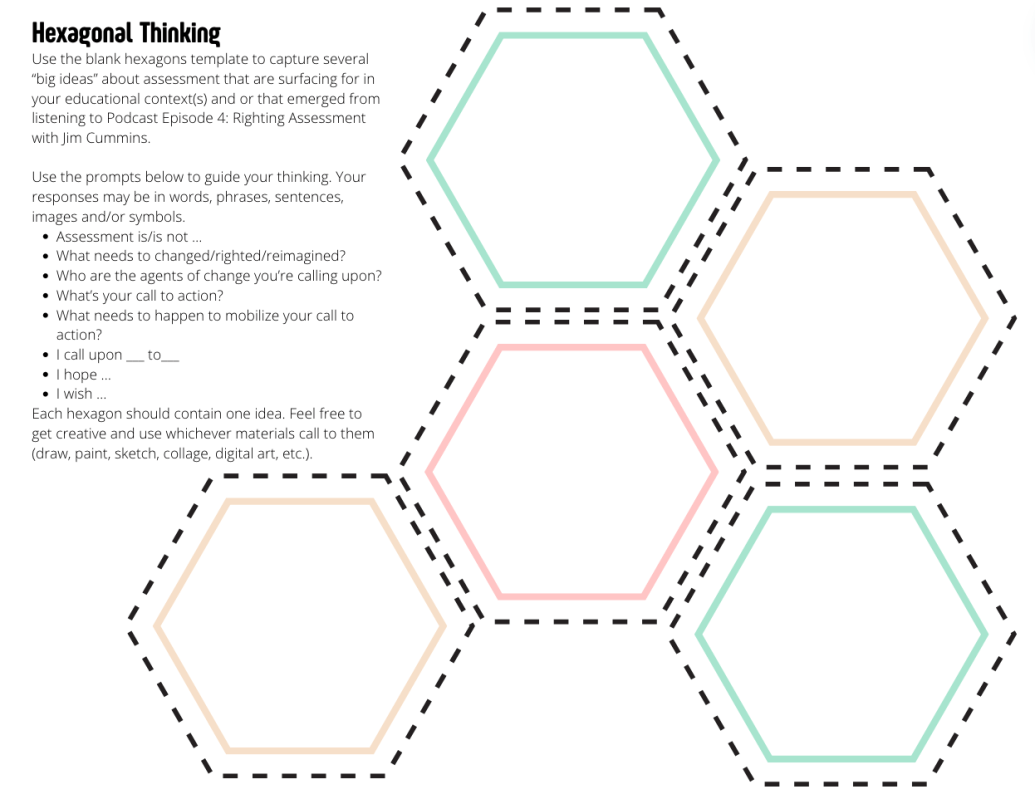
Hexagonal thinking is a conversational strategy that invites creativity, critical thinking, and collaborative listening and sharing. They can be used with both young learners and adult learners.
Invite conversation participants to use our blank hexagons template to capture several “big ideas” about assessment that are surfacing for them in their educational context(s) and or that emerged from listening to one of our podcasts. This may be an idea that has moved them, provoked them, challenged them, and/or inspired them.
Use may also wish to have participants use the prompts below to guide their thinking. Hexagon ideas may be in words, phrases, sentences, images and/or symbols.
- Assessment is/is not …
- What needs to changed/righted/reimagined?
- Who are the agents of change you’re calling upon?
- What’s your call to action?
- What needs to happen to mobilize your call to action?
- I call upon ___ to___
- I hope …
- I wish …
Each hexagon should contain one idea. Encourage participants to create multiple hexagons and get creative and use whichever materials call to them (draw, paint, sketch, collage, digital art, etc.).
To prepare for conversation, participants should follow dotted lines to cut out their idea hexagons.
How to use hexagonal thinking to facilitate conversation:
This discussion strategy encourages participants to connect ideas to create a web of related concepts.
- Participants listen to one of our podcast episodes and view it’s accompanying sketchnote and then prepare for the discussion by creating numerous hexagon ideas, ready to share in a group discussions.
- Have participants form a small group (3-4 people) with discussion space that has a flat open space in the middle (floor/table).
- One participant volunteers to begin the discussion by placing their hexagon in the middle of the table/floor and explaining their big idea.
- When the first participant has finished discussing their hexagon, another participant can go next. The second participant can select a hexagon they’ve created and explain how their idea connects to the previously placed hexagon. Have them place their hexagon on the floor/table next the the first hexagon.
- Repeat step 4, having each participant take turns placing, explaining and connecting their hexagon to the adjoining hexagon(s). This make take several go rounds of the group.
- Once participants have placed, explained and connected all of their hexagons, encourage them to look at the web of related concepts as a whole and consider ways in which their thinking may have been deepened, changed, challenged or affirmed.

 undoing, decolonizing, liberating, righting and reassembling literacies assessment